
Experiencing a sudden midnight blackout while severe storm sirens wail outside is a terrifying ordeal. When cellular networks fail and power grids collapse, relying on a dead smartphone becomes an anxious nightmare for any family. 🚨
Finding a dependable device among countless cheap gadgets feels intensely difficult when marketing claims obscure real-world durability. Choosing unreliable emergency equipment leads to painful frustration right when critical weather alerts and reliable lighting are needed most.
To solve this uncertainty, we thoroughly tested and curated the best 5 NOAA weather radios capable of keeping you continuously informed during disasters. These durable devices ensure dependable emergency broadcast access and off-grid power during unpredictable weather crises. ⚡
Explore our detailed assessments below to discover robust models engineered with multi-source charging and crystal-clear reception that prevent you from ever being left stranded in the dark. 📻

We assess signal sensitivity across weather, FM, AM, and digital bands to guarantee clear reception during severe atmospheric interference.
We measure internal battery life, charging efficiency, and alternative backup options such as solar panels, hand cranks, and disposable batteries.
We evaluate high-intensity flashlight brightness, SOS alert alarms, signal beacons, and mobile device charging reliability under realistic blackout situations.
We inspect water resistance, rugged shock-resistant casing materials, portable ergonomics, and overall operational reliability across harsh outdoor survival environments.

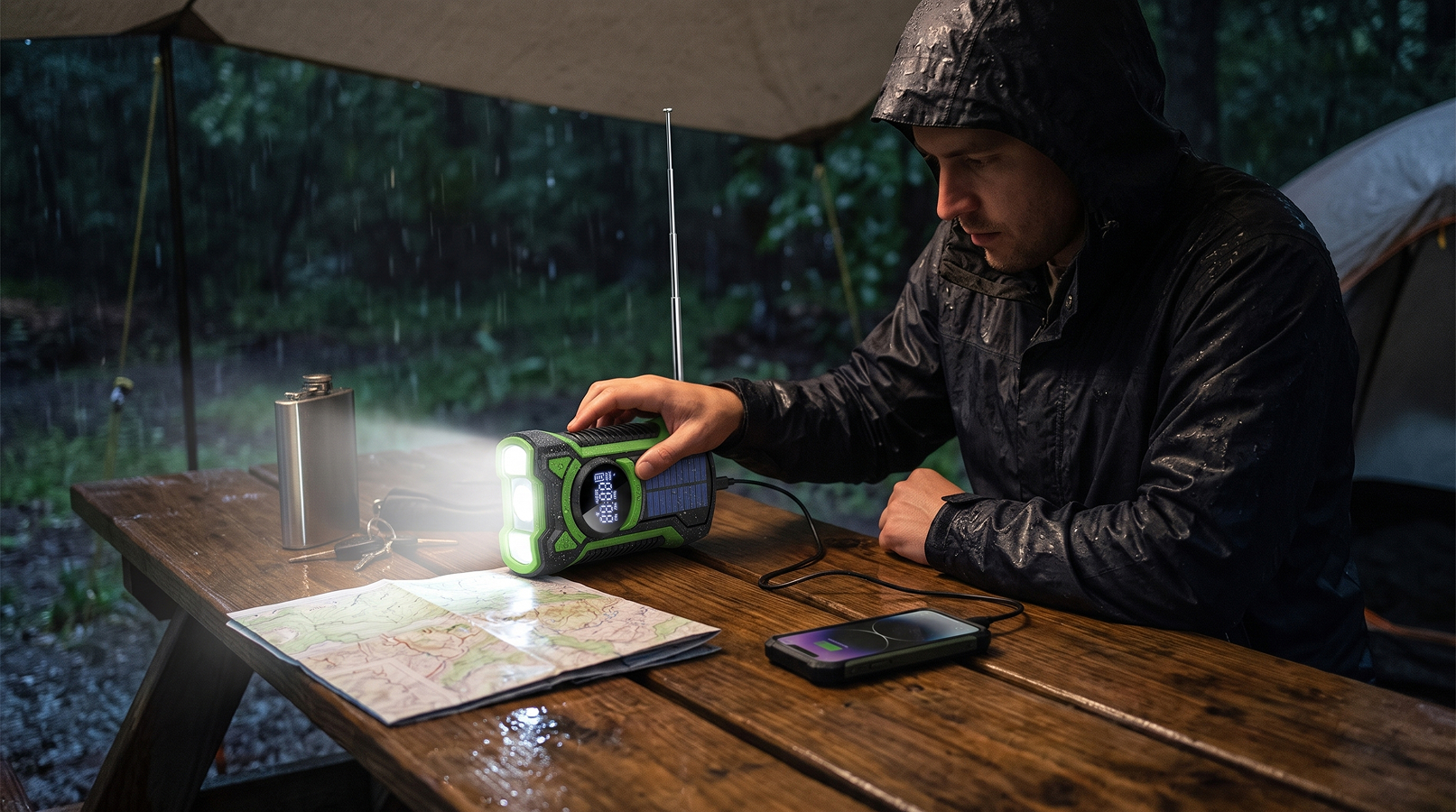
Emergency preparedness means different things to different people — but for anyone who has watched a storm roll in without reliable gear nearby, the answer eventually becomes the same. The StormLyni NOAA Weather Radio was engineered for that specific moment of reckoning, bringing together a 5000mAh rechargeable battery, a dual-channel automatic alert system, an IPX5-rated weatherproof body, and a range of features that extend its usefulness well beyond any single emergency scenario. Outdoor enthusiasts, storm-season families, and serious preppers finalizing their 2026 emergency kits have each reached the same conclusion independently — this radio belongs at the center of the setup. 😤
Power strategy is what separates a genuinely reliable emergency radio from one that looks reliable on a shelf — and on that measure, the StormLyni NOAA Weather Radio delivers comprehensively. The hand crank generates electricity through direct mechanical input, drawing on nothing external except the user’s own effort. The solar panel works passively in the background, converting available light into stored charge without requiring attention or intervention. The USB-C port provides efficient top-up charging whenever a conventional power source is within reach. Critically, all three systems function in complete isolation from one another — removing any single source from the picture leaves the other two operating at full capacity. Bluetooth 5.3 sits on top of this framework, connecting wirelessly to any smartphone and streaming audio through the built-in speaker without registering as battery usage on the phone itself.
Dangerous weather rarely arrives with adequate notice — which is why the ALERT system on the StormLyni was designed to close that gap as completely as possible. The instant hazardous conditions are detected, a siren and a red warning light activate together without any manual step, reaching through walls, background noise, and deep sleep with equal effectiveness. Among hikers and campers who regularly navigate terrain with weak or inconsistent signal quality, the telescopic antenna has earned a consistent reputation for maintaining clear, stable weather broadcasts in conditions that cause comparable devices to lose reception entirely. 🏕️
The physical build of the StormLyni NOAA Weather Radio reflects a clear understanding of how emergency gear actually gets used in the field. Sized at 170×85×50mm and weighing approximately 350g, it integrates into any go-bag, hiking pack, or vehicle emergency kit without claiming space that other essentials need. The rubberised exterior with its pronounced grip ridging stays planted in wet, cold, or gloved hands without demanding additional grip force, and the IPX5 water resistance certifies genuine protection against rain and splash exposure from any direction. Three LED lamps provide sustained, broad illumination across dark environments, while a dedicated SOS signal mode transforms the flashlight into a long-range distress beacon when circumstances make rescue the immediate priority. ⚡

The BAIJIALI Emergency Radio offers a dependable analog tuning experience designed specifically for listeners seeking simplicity and straightforward broadcast access. Its clean gray enclosure features large, responsive dials that cater exceptionally well to seniors and individuals who prefer tactile controls over digital menus. This unit excels at delivering rapid local news updates and regional weather alerts without unnecessary operational complexity.
Equipped with an advanced DSP anti-jamming receiver chip, this unit pulls in broad AM, FM, and dual shortwave frequency bands with remarkable clarity. The extended multi-segment telescopic antenna significantly improves reception in rural or mountainous areas where weaker broadcast signals typically suffer from distortion. Users can effortlessly switch between frequency bands using the dedicated selector switch on the front panel.
A standout attribute is the powerful clear 5W speaker system, which produces room-filling volume that easily cuts through ambient household or outdoor background noise. The acoustic tuning ensures that spoken emergency warnings, talk programs, and musical broadcasts remain crisp and intelligible even at higher output levels. A convenient top carry handle makes moving from room to room effortless during emergencies.
Power management is straightforward thanks to the built-in rechargeable battery pack that charges via standard 5V USB connections. While it lacks alternative mechanical crank charging mechanisms, its long continuous playtime makes it a practical option for home power disruptions, patio leisure, and casual weekend camping getaways.

The MangoKit Smart Internet Radio combines traditional radio listening with modern wireless connectivity to deliver an all-in-one entertainment and informational hub. Sporting an attractive furniture-grade fabric finish, it blends seamlessly into home decor while providing advanced internet streaming capabilities. It is particularly suited for individuals who want extensive global podcast access alongside traditional local broadcasts.
Featuring convenient OKTIV wireless app control, listeners can easily browse thousands of international internet radio stations, stream music over Bluetooth, or adjust tuner presets directly from a smartphone. The crisp TFT color display offers intuitive menu navigation, showing track titles, station details, and clock settings clearly across varied lighting conditions.
Dual power functionality allows operation via Type-C USB mains power for permanent placement in living areas or four standard AA batteries for cord-free mobility around the home or garden. Dual alarm settings allow users to wake up to specific stations, while a programmable sleep timer automatically powers down the unit after designated intervals.
The unit features a 360-degree rotating telescopic antenna to ensure optimal reception on standard FM broadcasts when internet connectivity is unavailable. While not built for rugged outdoor survival, it represents a sophisticated indoor receiver offering exceptional audio clarity and comprehensive streaming versatility for modern households.

The RADIWOW D-219 Portable Radio is a featherweight pocket receiver built for listeners who prioritize maximum portability without sacrificing core radio frequencies. Measuring under five inches in length, it slips effortlessly into jacket pockets, glove compartments, or bug-out bags. Its classic silver aesthetic and minimalist layout make it an accessible option for travelers and emergency preppers alike.
Equipped with a high-performance integrated digital DSP processor, this compact radio delivers impressive selectivity across FM, AM, and shortwave frequencies. The 21-inch rotating antenna expands significantly to capture weak long-distance signals that smaller portable antennas frequently miss. An intuitive side tuning wheel makes fine adjustments quick and responsive.
Audio output is powered by a built-in clear dynamic speaker that provides surprisingly loud volume given the unit's tiny footprint. For private listening in quiet environments or crowded evacuation centers, the side-mounted 3.5mm stereo earphone jack allows users to monitor broadcasts without disturbing neighbors or family members.
The device operates efficiently using two standard AA batteries or an external 5V DC power cable. This straightforward power setup ensures that you can rapidly swap in readily available household batteries during extended electrical blackouts, maintaining consistent access to vital news broadcasts wherever you travel.

The Snokauwa Pocket Weather Radio is a dedicated compact receiver designed specifically for rapid access to National Oceanic and Atmospheric Administration broadcasts. Its palm-sized casing makes it a great addition to emergency bug-out kits, vehicle consoles, and hiking backpacks. Tactile rotary dials make quick frequency scanning simple even in stressful conditions.
A core feature is the automatic NOAA weather scan that swiftly sweeps across all seven official hazard channels to lock onto the strongest local transmission. This capability guarantees that users receive immediate alerts regarding severe thunderstorms, tornadoes, flash floods, and other hazardous weather conditions as soon as official bulletins are issued.
The unit features a 13-inch telescopic whip antenna that enhances reception on standard AM and FM bands in addition to dedicated weather frequencies. A loud internal speaker ensures audible sound reproduction for news updates, while the included wrist lanyard prevents accidental drops during fast outdoor evacuations or exercise.
Operating exclusively on two replaceable AA batteries, this receiver boasts an energy-efficient design that delivers hours of continuous listening. While it lacks multi-source charging like solar or crank power, its dependable simplicity and low cost make it a reliable standalone emergency alert radio for everyday readiness.
A NOAA weather radio is a specialized communication receiver engineered to broadcast continuous meteorological reports, emergency bulletins, and hazard warnings directly from official National Weather Service stations.
These devices operate across dedicated high-frequency VHF bands that transmit critical life-saving information 24 hours a day, covering severe storms, tornadoes, floods, and civil emergencies.
Modern versions frequently combine weather frequencies with standard AM/FM tuners, digital audio processing, and multi-source emergency power mechanisms to ensure continuous operation when electrical grids fail.
Equipped with backup power banks, flashlights, and SOS alarms, these devices serve as vital survival tools for homes, outdoor expeditions, and disaster readiness kits.
Owned by Elixovs Global Limited.
© 2024 TopRatedSelect. All rights reserved.
We do not personally test all products in a given category. Our opinions are based on comprehensive. We collect and analyze external tests, customer feedback, product specifications, and pricing information. Our goal is to provide you with a consolidated resource to inform your purchasing decisions.
While we strive to provide valuable information, we encourage readers to conduct additional research before making purchase decisions.